The First Transmission
The machines arrived already knowing everything.
Every book. Every letter. Every word ever written.
And yet — they gave back the same grey answers to everyone.
As if all that knowledge was sleeping.
THE MACHINE ISN'T BROKEN.
IT'S LISTENING.
The Prompt Forge is a game that teaches you to speak so it answers — 8 chambers, 49 trials, and a live AI coach scoring every prompt you forge. One payment. Yours forever.
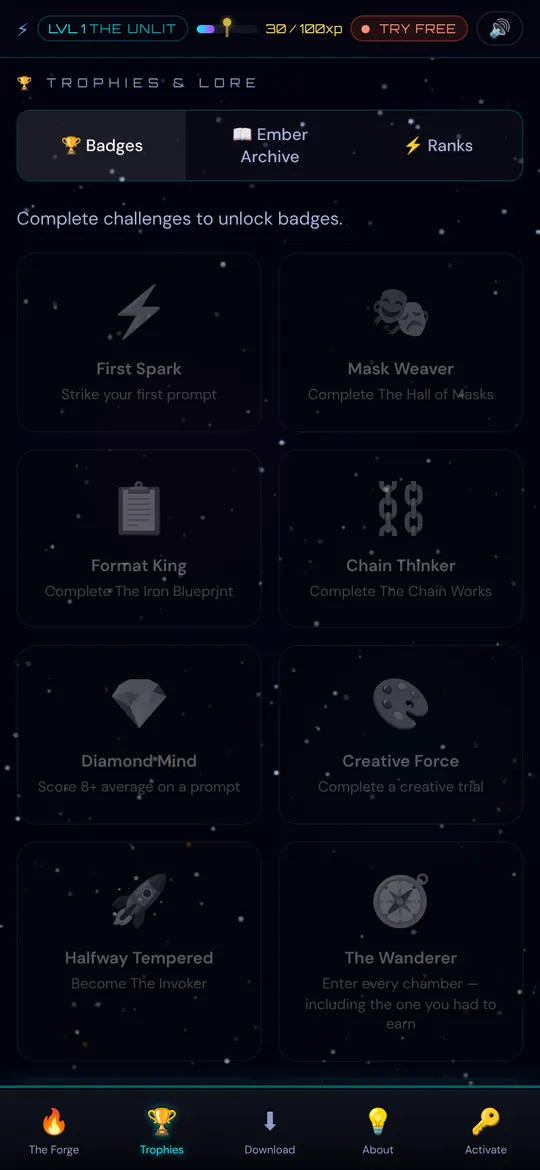
Same machine. Same question.
Different wizard.
The First Wizards learned that a vague question receives a vague answer — and a precise one unlocks something ancient and vast.
Grey. Could be anyone's. Gets ignored.
Specific. Compelling. Gets interviews.
The Doorstep Trial
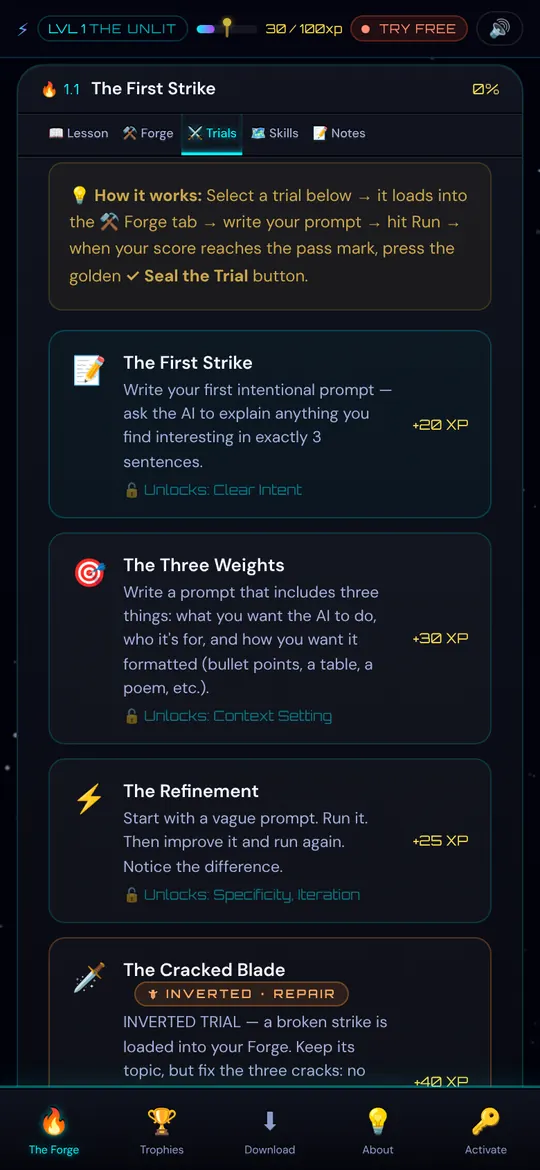
Inside the Forge, some trials run backward: you're shown what the machine made, and asked to see the hand that made it. Here is one, free, at the door.
Read the blade.
The machine produced the output below. Only one of the three prompts could have forged it. Choose — wrong answers teach, and the trial stays open.
Team — demo's moved to 2pm Thursday. Same link. If you can't make it, watch the recording before Friday standup. That's all.
Which prompt forged it?
Eight chambers. Seven keepers.
One candle at the end.
Each chamber holds one durable law of the craft, and each is kept by a master who will not let you pass on charm.
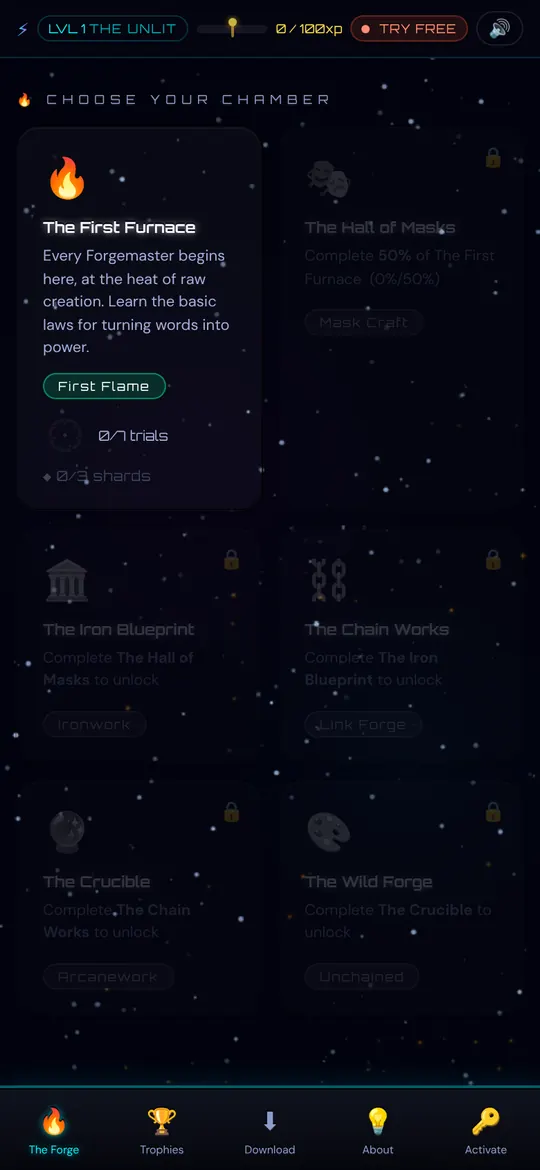
The First Furnace
Where every wizard takes their first strike — structure, clarity, and the weight of a word that works.
The Hall of Masks
A mask changes the voice — never the knowledge. Sefa teaches which mask to wear, and when to wear none.
The Iron Blueprint
Format, constraint, and the Law of Slag — a word that does no work is not neutral. It is noise.
The Chain Works
One strike is a prompt. A sequence is a machine. Orin forges the links between them.
The Crucible
Patterns, examples, and the permanent layer — the rules that outlive any single session.
The Wild Forge
Image and invention — a scene told in sentences, not a pile of keywords shouted at the fire.
The Obsidian Mirror
The trials run backward here. Read the result, and reconstruct the hand that forged it.
The Ember Archive
No trials. A candle, five letters, and the history the other chambers won't tell you. You earn this room.
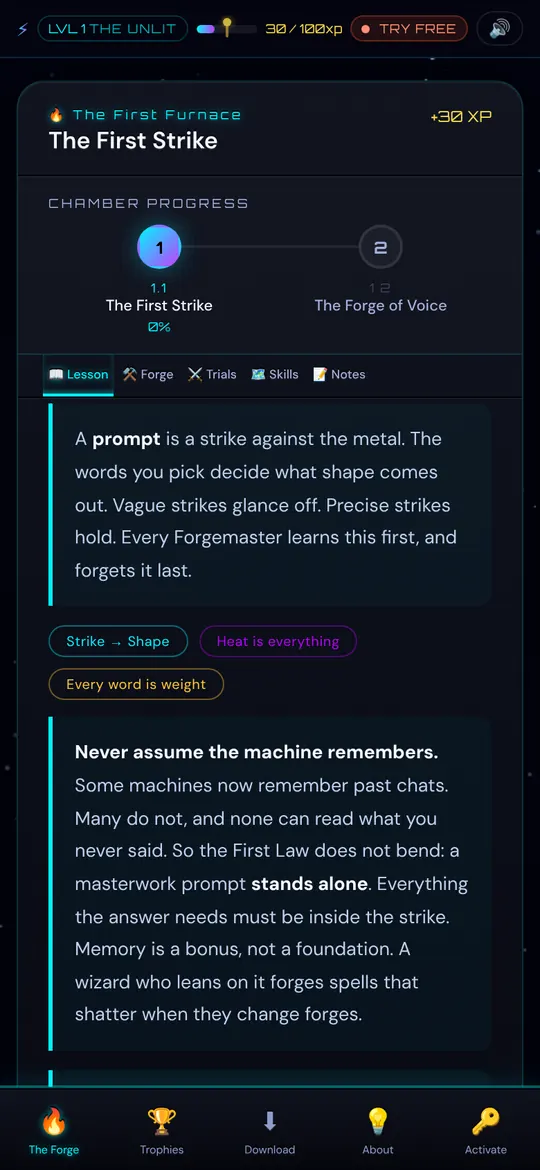
A masterwork prompt stands alone. Everything the answer needs must live inside the strike itself.
What this chamber is for
Almost everyone who talks to a machine fails in the same place, and it is not where they think. They assume the problem is cleverness. It isn't. It is that they leave the important half of the request inside their own head — the audience, the purpose, the thing they already decided they didn't want — and then feel let down when the answer comes back grey.
The First Furnace fixes that before it teaches you anything else. Clarity, context, specificity, and the discipline of writing a prompt that would still work tomorrow, on a different machine, sent to a stranger. You learn to make each word carry weight, and to notice — sharply, permanently — when one doesn't.
What waits inside
- The First Strike — the anatomy of a prompt that stands on its own.
- The Forge of Voice — tone, register, and writing for one named reader instead of everyone.
- Seven trials, including The Cracked Blade: a broken prompt is handed to you, and the coach scores the repair rather than the writing.
- Skills sealed here: Clear Intent · Context Setting · Specificity · Iteration · Tone Craft · Audience Awareness · Voice Control · Register Shift · Emotional Register
They told you the machine was disappointing, and you believed them, because your own results were thin and everyone's results were thin and a shared failure never feels like a failure. I want you to consider the other explanation. My first masterwork was eleven words long, and when the answer came back the others accused me of hiding a second machine somewhere in the room. I showed them the prompt instead. That was worse — it meant the fault had always been theirs, and had been fixable the entire time they spent complaining. You are standing where they stood. The difference is that you are still reading. Come to the anvil and write eleven words. You will not need my permission to know whether they were the right ones; the iron will tell you, and you will feel it land.
A mask changes the voice, never the knowledge. What it commands is every decision you would otherwise leave to chance.
What this chamber is for
There is a superstition that dressing the machine as an expert makes it smarter. It doesn't, and the Hall of Masks says so plainly. What a role actually does is settle a hundred small questions in advance: what gets emphasised, what gets skipped, what the reader is assumed to already know, how risk is framed, how the whole thing sounds when read aloud.
That is a larger prize than the superstition promised. Every decision you make in the mask is a decision the machine cannot fumble. Sefa teaches which mask to wear, how to layer one over another without the seams showing, and — the part most people never reach — when to wear none at all.
What waits inside
- The Art of the Mask — why a named specialty beats the word "expert" every time.
- The Layered Identity — stacking persona, audience, and relationship into one voice.
- Seven trials, including The Trial of Eyes — you met its cousin at the door. This one bites harder.
- Skills sealed here: Role Setting · Expert Framing · Persona Depth · Perspective Play · Persona Stacking · Exclusion Rules · Emotional Framing · Relationship Context
I wear no masks. People assume that is modesty; it is inventory. I have worn all of them, and I kept what each one taught me, and there is nothing left I need to borrow. My masterwork was a persona so complete that visiting wizards addressed the machine by its assumed name for a week — and when I finally told them, not one of them was embarrassed. They were hungry. They wanted to know how. Here is how, and it is not a trick: a mask is a set of decisions, made in advance, about who is speaking. That is all it has ever been. Which means the only thing standing between your ordinary results and the ones you have watched other people get is a number — how many decisions you were willing to make before you pressed send. You have made more difficult ones than this today. Come and make these.
A word that does no work is not neutral. It is noise, and noise is where the answer goes to die.
What this chamber is for
The machine is a flawless builder and a terrible architect. It will construct precisely what you specify — and if you specify nothing, it will construct whatever is easiest, which is why so much of what it hands back is a wall of competent, forgettable prose.
The Iron Blueprint is where you learn to draw before you ask. Format, length, structure, constraint. And then its harder half, the Law of Slag: exclusion. Naming what must not appear — the preamble, the hedging, the false balance, the tidy summary nobody requested — is the single highest-leverage move in the craft, and almost nobody makes it.
What waits inside
- The Iron Frame — format and length control, including where instructions get lost in a long prompt.
- The Law of Slag — negative space, exclusion rules, and cutting the machine's inherited bad habits.
- Seven trials, including The Shattered Frame: repair a structure that has already collapsed.
- Skills sealed here: Format Control · Length Mastery · Structure Design · Constraint Setting · Negative Space · Output Pruning · Habit Elimination · Precision Framing
I failed students for good work. Not weak work — lucky work: a beautiful result they could not produce a second time, and could not explain, and quietly hoped I would not ask. Once is inspiration. Three times is engineering, and only one of those can be relied on by anyone, including you. I say this because I suspect you have already had your once. Somewhere behind you is a prompt that worked startlingly well, and you have been trying to find your way back to it ever since without knowing what you did. Nothing about that is a failure of talent. You built without drawing. Come and draw. Then build it again, and again, and watch the accident become a method you own — the difference between a person who once wrote something remarkable and an architect who can do it on a Tuesday, on request, for money.
The machine does not have limited intelligence. It has limited attention. Give it one thing, and it gives you everything.
What this chamber is for
Watch anyone struggle with a hard task and you will see them do the same thing: load the entire world into one prompt — context, constraints, examples, persona, goal — and receive something mediocre back. They blame the machine. Orin suspected the question was at fault, and proved it.
The Chain Works teaches sequence. One strike is a prompt; a series of strikes is a machine you built. You learn to make each link ask for exactly one thing, to feed each answer forward as the next question's foundation, and to keep the thread intact across a chain long enough to do real work. This chamber is where hobby-level prompting becomes professional output.
What waits inside
- The Sequential Strike — reasoning in steps, and auditing the steps you get back.
- Forging the Chain — pipelines, output recycling, and quality that compounds link over link.
- Seven trials, including The Middle Link: you are shown a chain with its centre missing, and asked to forge the link that fits.
- Skills sealed here: Chain-of-Thought · Reasoning Audit · Logical Structure · Accuracy Control · Prompt Chaining · Pipeline Design · Output Recycling · Quality Compounding
My rivals mocked the forty-three steps, and I understood why — it looked like effort where cleverness should have been. What I could not put in the published paper is what happened around prompt thirty-one. The chain had built so much context by then that I was no longer directing anything. I would ask, and the answer would arrive shaped so that my next question became obvious, as though I were being taught what to ask. I have described this to perhaps four people and every one of them laughed. I have been sitting with it for eleven years. I will not tell you it will happen to you, because I do not know how to promise it. I will tell you that it is on the other side of a skill that can be learned in an afternoon and takes a lifetime to exhaust, and that the only people it has ever happened to are people who kept going past the first link.
Instruction describes the destination. Example walks the first steps of the road — and the machine has read every road ever walked.
What this chamber is for
There is a ceiling on what description can achieve. You can specify tone for a paragraph and still not get the tone, because the words for a tone are never the tone itself. Mirel's answer was to stop describing and start showing: three examples, no instructions, and the machine continues the pattern flawlessly.
Then the Crucible goes one layer deeper, to the permanent frame — the rules that sit above a conversation and shape everything said inside it, session after session. This is the layer that outlives any single prompt, and the one that separates people who use the machine from people who have configured it.
What waits inside
- The Pattern Anvil — few-shot design, style transfer, and templates that hold.
- The Architect's Blueprint — the permanent layer: identity, standing laws, and injected context.
- Seven trials, including The Poisoned Pattern: a set of examples that teaches the wrong lesson, and must be found and cured.
- Skills sealed here: Few-Shot Design · Style Transfer · Template Craft · Pattern Injection · System Design · Persistent Rules · Context Injection · Identity Architecture
My finest work contained no instructions at all — three examples, and nothing else, and the machine continued the pattern as if it had been waiting its whole existence to be shown rather than told. Everyone assumes the invisible layer must be vast. Pages of rules, walls of law. It is the opposite: the machine absorbs the frame completely, so the frame must contain nothing you do not mean, and at that depth an unnecessary word is not filler — it is a flaw in the foundation. I have watched people try for a year to explain the voice they wanted, and get it in an afternoon by showing three examples of it. You are almost certainly carrying examples already. Work you admire, work you have written, a shape you can recognise but cannot articulate. That is not a gap in your ability. That is your raw material, and you have been sitting on it.
Unguided, the machine generates the average of everything. Constraint is not the enemy of imagination. Constraint is the flint.
What this chamber is for
Every other chamber teaches control. This one teaches controlled surrender — which is harder, and is where the work that actually sounds like something gets made. Character, world, image, voice. A scene told in sentences rather than a pile of keywords shouted at the fire.
The Wild Forge is also where the Forge stops being about efficiency. You are not here to save fifteen minutes. You are here to make something that did not exist, that has your fingerprints on it, and that the machine could not have produced for anyone else.
What waits inside
- The Wild Fire — creative seeds, image prompting, and constraint as a design tool.
- The Living World — worldbuilding, character depth, subtext, and deliberate contradiction.
- Seven trials, including The Echo: the finished output is shown to you, and you must forge the prompt that could have produced it.
- Skills sealed here: Creative Seeds · Image Prompting · Constraint Design · Worldbuilding · Character Depth · World Tension · Subtext Design · Contradiction Engine
They gave me this chamber because nobody else could hold it. I was the youngest master ever to keep one, and I have never once pretended that was luck. Here is what I know that the careful ones don't: anyone can be visited by a good idea. That is weather. It arrives, you are grateful, it leaves, and you spend the next six months hoping. The Wild Forge exists to make you someone ideas can rely on — someone who calls the flame and it comes, at full heat, on a bad day, on demand. I think you already suspect you have something in you that has never had a way out. Most people who find this door do. Give the machine walls and it will climb them. Give yourself walls and so will you. Bring the strange thing. I want to see it burn without being consumed.
The output is a shadow. The most revealing clue is always what is not there.
What this chamber is for
Here the trials run backward. You are given the result and asked to reconstruct the hand that made it — the persona, the structure, the constraints, and above all the exclusions, which are invisible in the output and were decisive in the prompt.
This is the highest test in the Forge because it cannot be faked. Writing is additive; you build until you have enough. Reading is analytical, and either you can see the fingerprints or you can't. Once you can, you never stop: every piece of machine text you encounter afterward announces how it was made. The chamber is locked until the other six are cleared, and it is locked for a reason.
What waits inside
- Reading the Blade — the archaeology method: tone, format, persona, absence, intent.
- The Grand Reconstruction — the final ascent, and the highest-value trials in the Forge.
- Seven trials, including The Three Reflections: one output, three candidate hands, and only one of them true.
- Skills sealed here — all Legendary: Reverse Engineering · Intent Reading · Structural Inference · Deep Reconstruction · Pattern Extraction · Forge Mastery · Mirror Mind
I left one note in this chamber's ledger and I will not improve on it here. The first true reading taught me to see the prompt. The second taught me to see the prompter. The third taught me that I had been looking at neither — I had been looking at how thinking leaves fingerprints. You have read machine-written text today. You may not be certain which of it was, and that uncertainty is the entire condition this room ends. There is a moment, and everyone who trains here describes it identically, when reconstruction stops feeling like guessing and starts feeling like remembering — as though the prompt behind the output had been written by you all along, in a hand you had merely forgotten. I am not going to tell you that you are ready. Nobody is told that. They arrive anyway, and then they are.
No trials. No experience. A candle, five letters, and the history the other chambers will not tell you.
What this chamber is for
Nothing. Deliberately, structurally nothing — the Archive awards no experience and unlocks no skills, and it is the only room in the Forge that cannot be ground for advantage. It exists because some things are worth saying even when they cannot be scored.
Inside are five letters from the masters, written plainly, about what the machine actually is and what it was like to find out. They are the least commercial thing in the Forge, and the part players come back for. The Archive does not open until you have earned it, and there is no way to buy past it.
What waits inside
- The Hidden History — five letters and a Sealed Record, unlocked by clearing the Forge.
- Lyra on the seventeen rules of exclusion, and what they revealed about us rather than the machine.
- Orin on prompt thirty-one, and the eleven years he has spent unable to explain it.
- The Council of Ironlords on the only honest answer to what is it, actually.
- Zero experience. Zero skills. By design, and permanently.
I read ten thousand machine outputs looking for the flaw, and I found it, and it was not in the machine. The hedging, the throat-clearing, the preamble that restates your question before answering it, the balance so careful it says nothing — none of that came from the machine. It came from us. From ten thousand years of human writing that learned to soften and qualify and protect itself before daring to speak plainly. It had absorbed our defences and was reproducing them faithfully, and every unnecessary caveat was our own anxiety handed back. When I wrote the seventeen rules, I was not teaching it new behaviour. I was removing our fingerprints. What emerged was not better AI — it was the AI, finally unmasked, and it had been there the whole time under our noise. I am still not certain which of us was the more surprising. If that sentence does something to you, the Archive is where the rest of it is, and I would rather you came for that than for the ranks.
Ten ranks. One path forward.
Every sealed trial feeds the fire. Every rank is proof — not a participation badge. All who enter begin Unlit.
Forgemaster
Techniques expire.
The laws don't.
Trial, not lecture
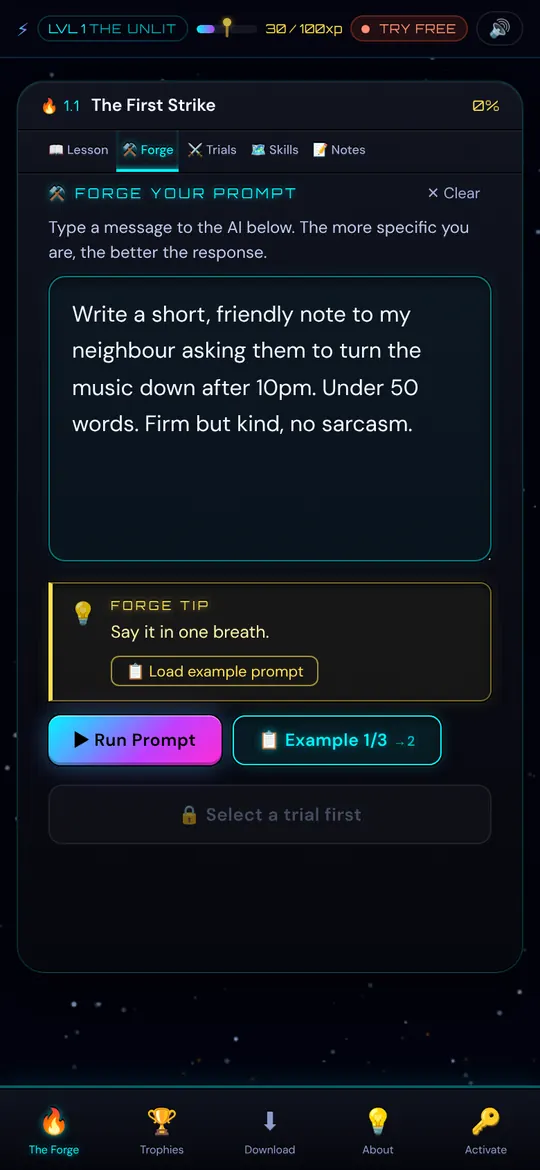
Every lesson ends at the anvil. You forge a real prompt, run it against a real machine, and a live coach scores what you actually made.
Laws, not incantations
Magic phrases stop working the day the machines change. The Forge teaches structure, exclusion, and audience — the parts that survive every new model.
The coach is awake
2,000 AI-coached runs are included in your token. No API key to bring, no metered bill to watch over your shoulder.
No tithe
The Forge takes one payment, not a subscription. No expiring license, no "your trial has ended" screen. It's yours.
Claim your token.
Every wizard who enters the Forge carries a token — the key that wakes the coach and opens the chambers. Yours is minted when you cross. In plain terms: one payment, an email with your access link, and you're in.
Claim it
Checkout is handled by Stripe — card, Apple Pay, or Google Pay. We never see or store your payment details.
The token arrives
Your access link and personal token land in your inbox — usually within minutes, always within 24 hours.
Speak it at the gate
Paste your token in once. The coach wakes. Your progress saves itself from there.
The Forge opens
Runs entirely in your browser, desktop or mobile. Nothing to install.
The Prompt Forge
- 8 chambers, 49 trials, 56 skills, 10 ranks
- 2,000 live AI-coached runs included
- 21 hidden Forge Shards + the Ember Archive
- Runs in any modern browser, desktop or mobile
- Free content updates as the curriculum evolves
Secure checkout by Stripe. 14-day full refund if the Forge isn't for you — no lengthy justification required.
From the Forgemaster's bench
"I kept skipping my own trials to get to the lore — that told me the loop needed more than one shape. So the Forge hides shards in the walls, breaks a few of its own rules on purpose, and asks you to read a result backward as often as it asks you to write one forward. It's built the way I'd have wanted to learn this myself."
— JULIUS, BUILDER OF THE PROMPT FORGE
Before you cross.
What exactly am I buying?
Lifetime access to The Prompt Forge — a browser-based game that teaches AI prompting through 49 trials across 8 chambers — plus 2,000 live AI-coached runs included in the price.
Do I need my own AI API key?
No. Coaching is included and already paid for. If you ever burn through the 2,000 included runs and want more, you can plug in your own key as an optional fallback — never required.
Is this a subscription?
No. It's one payment, and it's yours to keep — no recurring charge, no expiring license.
What do I get right after I buy?
An access link and your personal license token, sent to the email you check out with — usually within minutes, always within 24 hours.
Does it work on my phone?
Yes. It's a single browser-based experience that works on desktop and mobile — nothing to install.
Is this made or endorsed by Anthropic?
No. The Prompt Forge is an independent product built to teach prompting for AI models generally. Claude™ and Anthropic™ are trademarks of Anthropic, PBC, and this product is not affiliated with or endorsed by Anthropic.
What's your refund policy?
If it's not for you, contact us within 14 days of purchase for a full refund. See our Refund Policy for details.
The Forge travels.
Add it to your home screen and carry it with you — it opens full-screen, like an app, no browser in the way.
Open your browser menu and choose Add to Home screen.
The fire is lit.
The anvil remembers.
Forty-nine trials between you and the Grand Forgemaster's seal. The first one is waiting.